


Bloom’s Taxonomy Made Practical: What It Is, Why It Matters, and How to Use It in Teaching
Imagine asking students only to memorize definitions before an exam. They might score well, but can they solve problems, make decisions, or create solutions? Effective learning goes far beyond remembering facts. This is where Bloom’s Taxonomy becomes invaluable.
Developed by Benjamin Bloom and colleagues in 1956 and revised by Anderson and Krathwohl in 2001, Bloom’s Taxonomy is one of the most widely used frameworks for designing learning objectives, teaching strategies, and assessments. It helps educators move students from remembering information to thinking critically and creating new ideas.
What Is Bloom’s Taxonomy?
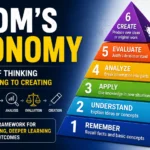
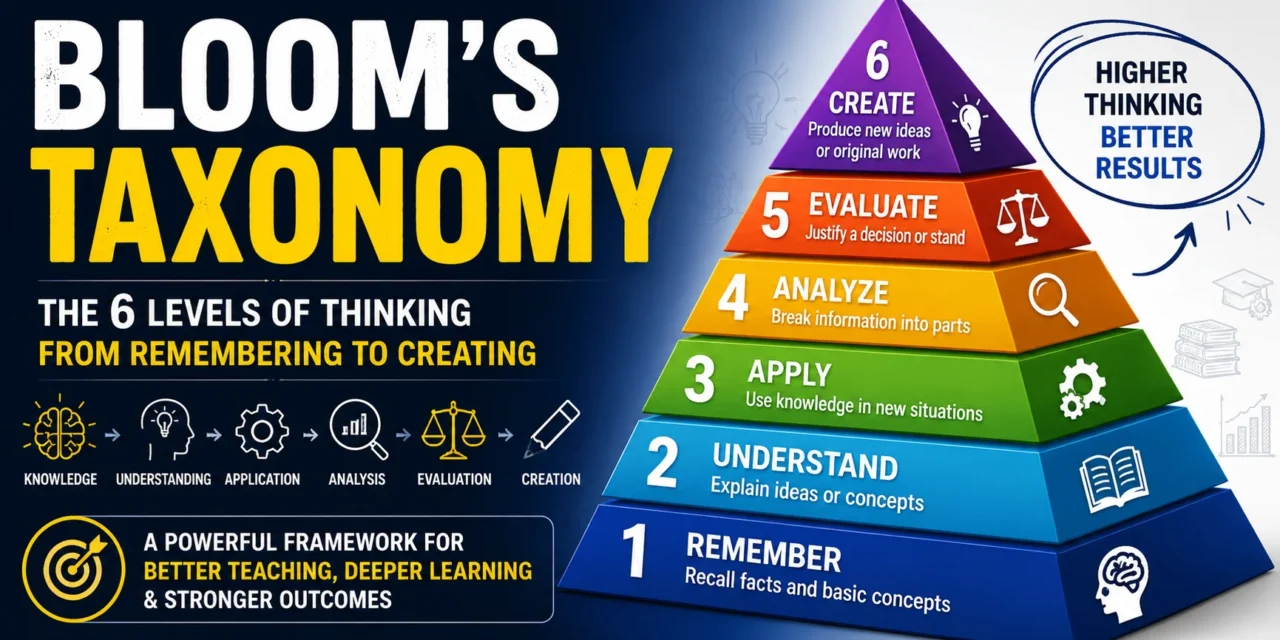
Bloom’s Taxonomy is a hierarchical framework that classifies cognitive learning into six levels, arranged from simple to complex thinking.
Rather than asking only “What should students know?”, it asks:
“What should students be able to do with what they know?”
The framework helps educators design learning experiences that progressively develop higher-order thinking skills.
Why Is Bloom’s Taxonomy Used?
Many courses focus heavily on factual recall, but real learning requires learners to apply knowledge, analyze situations, evaluate options, and create solutions.
Bloom’s Taxonomy helps educators:
- Write clear and measurable learning objectives.
- Design teaching activities that promote deeper learning.
- Choose assessments that match the intended learning outcomes.
- Develop critical thinking and problem-solving skills.
- Align teaching, learning, and assessment.
In short, it ensures students don’t just remember information—they use it effectively.
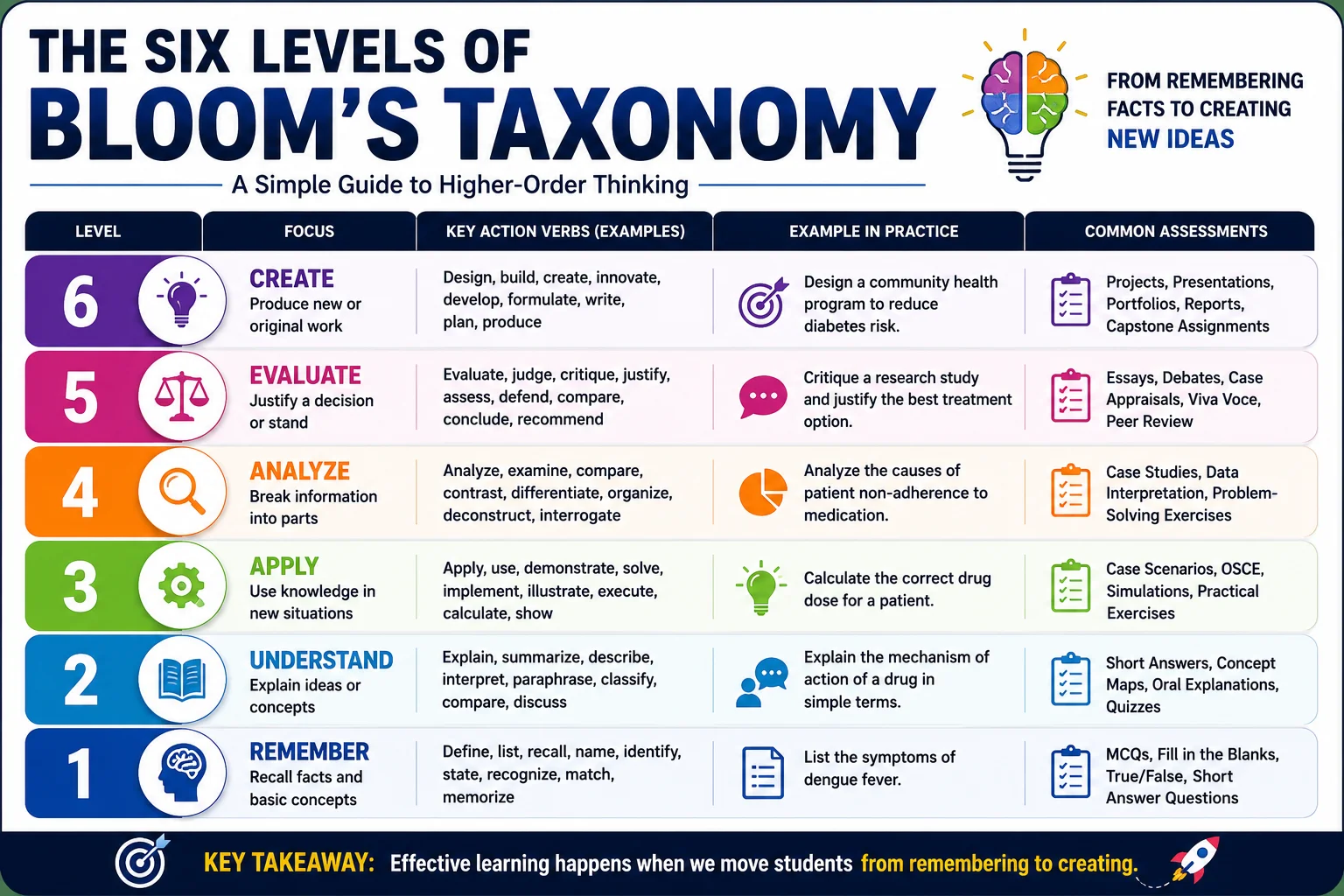
The Six Levels of Bloom’s Taxonomy
1. Remember
Question: Can the learner recall information?
This is the foundation of learning.
Examples
- Define diabetes.
- List cranial nerves.
- Recall normal blood pressure values.
Common Assessments
- MCQs
- Fill-in-the-blanks
- Short-answer questions
2. Understand
Question: Can the learner explain the concept?
Students demonstrate comprehension by interpreting or summarizing information.
Examples
- Explain how insulin regulates blood glucose.
- Summarize the stages of wound healing.
- Describe the mechanism of fever.
Common Assessments
- Short notes
- Concept maps
- Oral explanations
3. Apply
Question: Can the learner use knowledge in a new situation?
Learners begin solving practical problems.
Examples
- Calculate a drug dose.
- Select the appropriate investigation.
- Apply infection-control guidelines in a clinical scenario.
Common Assessments
- Case-based questions
- Clinical scenarios
- Problem-solving exercises
4. Analyze
Question: Can the learner break information into parts and identify relationships?
Students examine patterns, compare alternatives, and identify causes.
Examples
- Differentiate viral from bacterial pneumonia.
- Interpret laboratory results.
- Analyze an ECG.
Common Assessments
- Case discussions
- Data interpretation
- Comparative analysis
5. Evaluate
Question: Can the learner make justified decisions?
Students judge options using evidence and reasoning.
Examples
- Choose the most appropriate treatment plan.
- Critique a research paper.
- Justify antibiotic selection.
Common Assessments
- Debates
- Critical appraisal
- Essay questions
6. Create
Question: Can the learner produce something new?
This is the highest level of cognitive learning.
Examples
- Design a patient education plan.
- Develop a research proposal.
- Create a quality improvement project.
Common Assessments
- Projects
- Presentations
- Portfolios
- Capstone assignments
A Practical Example
Suppose you’re teaching Hypertension.
| Bloom’s Level | Learning Activity | Assessment |
|---|---|---|
| Remember | Recall diagnostic criteria | MCQ |
| Understand | Explain the causes of hypertension | Short answer |
| Apply | Select treatment for a patient | Case scenario |
| Analyze | Compare two antihypertensive drugs | Case discussion |
| Evaluate | Justify the best management plan | Essay or viva |
| Create | Design a hypertension awareness program | Project or presentation |
Notice how learning progresses from simple recall to real-world problem-solving.
How Educators Use Bloom’s Taxonomy
A simple approach is:
- Define what learners should achieve.
- Choose the appropriate Bloom’s level.
- Write measurable learning objectives using action verbs.
- Design learning activities that match the objective.
- Select assessments that measure the intended level of thinking.
For example:
Learning Objective:
“By the end of the session, students will be able to analyze ECG findings to identify common cardiac arrhythmias.”
Teaching: ECG interpretation workshop
Assessment: Case-based ECG analysis
Everything is aligned with the Analyze level.
Strengths of Bloom’s Taxonomy
- Simple and easy to apply.
- Encourages higher-order thinking.
- Improves curriculum planning.
- Supports outcome-based and competency-based education.
- Aligns learning objectives, teaching, and assessment.
- Applicable across schools, universities, healthcare, and corporate training.
Limitations
- Learning is not always strictly hierarchical.
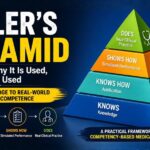
- Practical skills and professional attitudes require additional frameworks (e.g., Miller’s Pyramid for clinical competence).
- Real-world performance depends on more than cognitive ability alone.
Key Takeaways
Bloom’s Taxonomy helps educators design learning that progresses from knowing to thinking critically.
The six levels are:
- Remember – Recall facts.
- Understand – Explain ideas.
- Apply – Use knowledge in practice.
- Analyze – Break down and interpret information.
- Evaluate – Make evidence-based judgments.
- Create – Design or develop something new.
The most effective courses include learning activities and assessments across multiple levels, ensuring students develop not only knowledge but also the ability to apply, evaluate, and innovate.
Final Thought
Bloom’s Taxonomy is more than a classification of learning objectives—it is a practical blueprint for designing meaningful education. By intentionally moving learners from Remember to Create, educators can foster deeper understanding, stronger clinical reasoning, and lifelong learning skills that prepare students for real-world challenges.
This post may contain affiliate links, which means I may earn a commission for purchases made through these links. Your support will encourage us to continue adding value to you through blogs like this. Learn more on my Private Policy page.