


Merrill’s First Principles of Instruction: A Practical Guide to Designing Learning That Works
Many courses are packed with information, yet learners often struggle to apply what they have learned in real-world situations. The reason is simple—learning happens best when learners actively solve problems, practice skills, and apply knowledge, rather than just consume content.
This is the foundation of Merrill’s First Principles of Instruction, one of the most practical instructional design models for creating effective learning experiences.
Developed by Dr. M. David Merrill (2002), the model provides a simple, evidence-based framework for designing instruction that leads to meaningful learning and long-term performance.
What Are Merrill’s First Principles of Instruction?
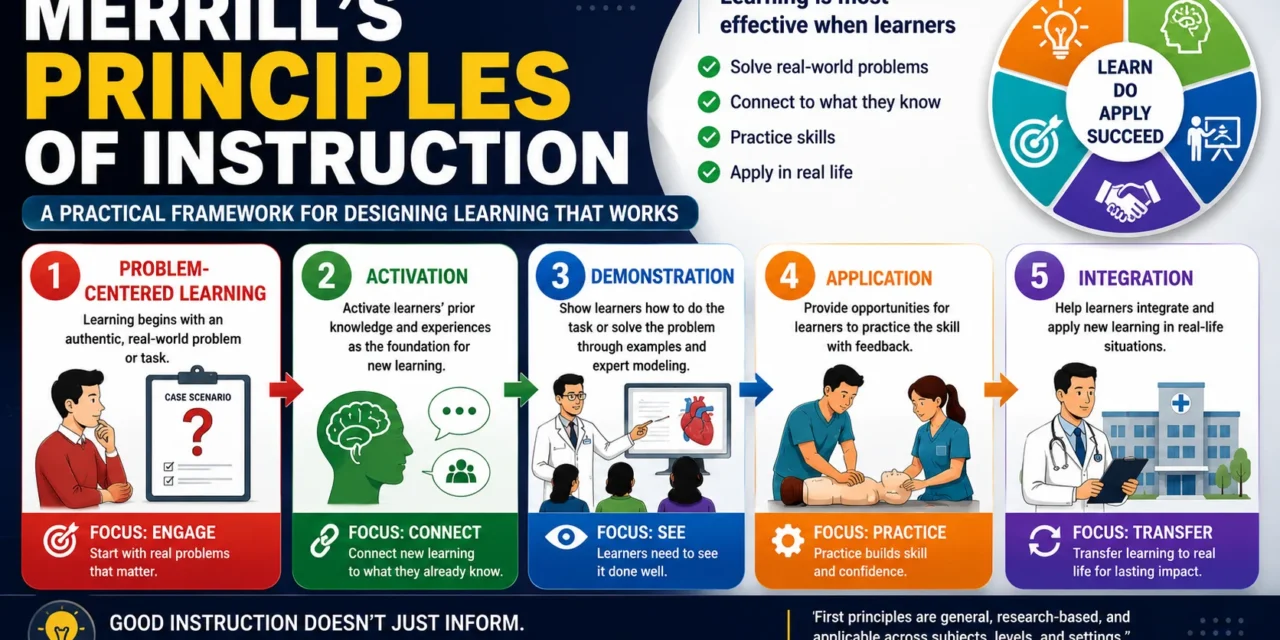
Merrill’s model identifies five core principles that make learning more effective.
Rather than asking,
“What content should I teach?”
it asks,
“How should I design learning so learners can successfully perform real-world tasks?”
The model emphasizes learning by doing, not just learning by listening.
Why Is Merrill’s Model Used?
Many training programs focus on delivering information rather than building competence.
Merrill’s model helps educators:
- Design learner-centered instruction
- Improve knowledge retention
- Develop practical skills
- Increase learner engagement
- Bridge the gap between theory and practice
- Support competency-based education
Instead of passive lectures, learners actively apply their knowledge throughout the learning process.
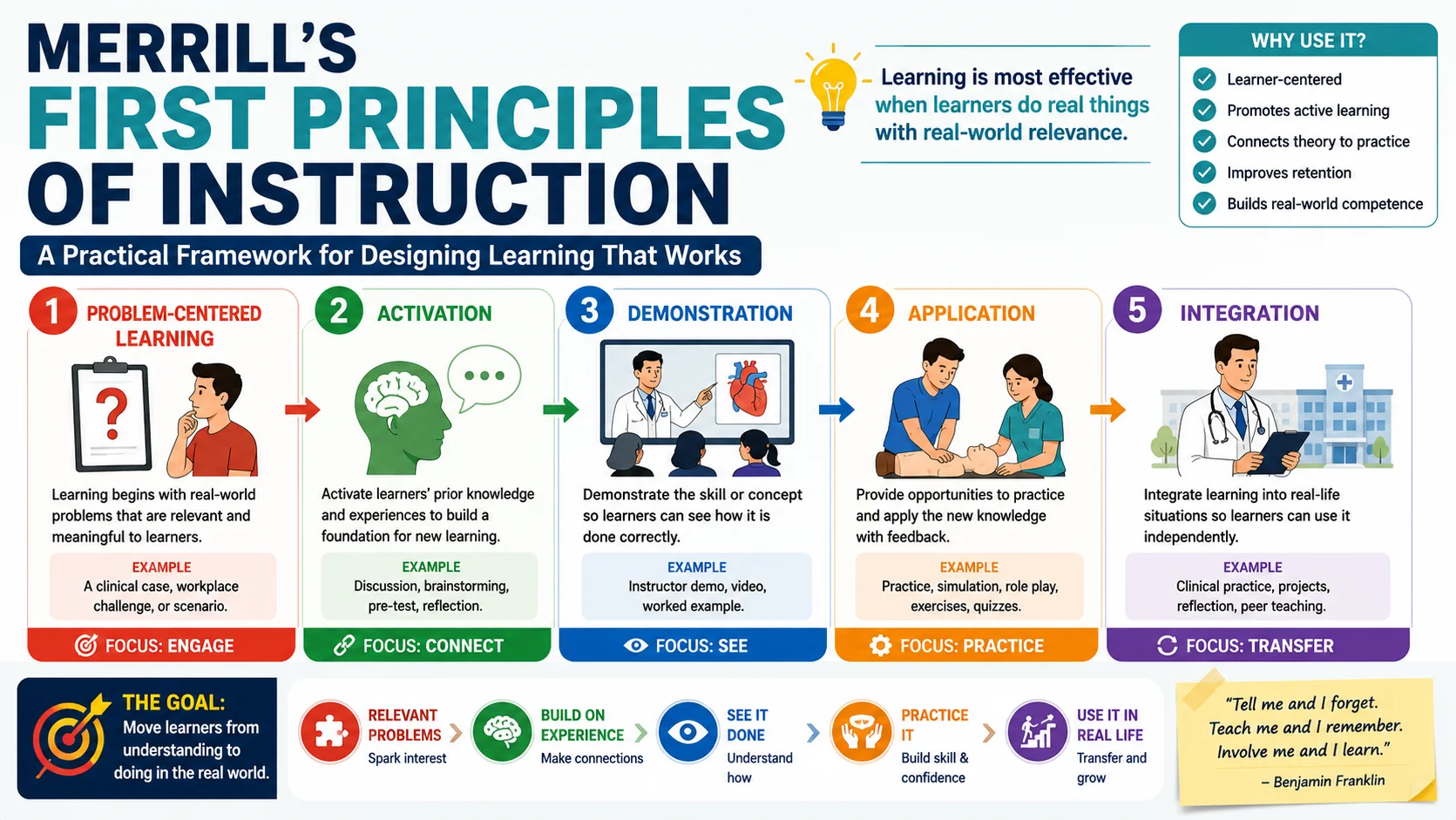
The Five First Principles of Instruction
1. Problem-Centered Learning
Question
Are learners solving real-world problems?
Learning should begin with an authentic task rather than isolated facts.
Examples
- Clinical case
- Business scenario
- Engineering challenge
- Patient management problem
Teaching Activities
- Case-based learning
- Problem-based learning (PBL)
- Simulations
- Scenario discussions
Example
Instead of teaching ECG theory first, present a patient with chest pain and ask learners to interpret the ECG.
2. Activation
Question
What do learners already know?
New learning becomes easier when connected to prior knowledge and experiences.
Teaching Activities
- Brainstorming
- Pre-tests
- Reflection
- Discussion
- Concept maps
Example
Before teaching hypertension, ask learners what causes high blood pressure and how they currently manage patients.
3. Demonstration
Question
Can learners see how the task is performed?
Learners need to observe experts performing the skill correctly.
Teaching Activities
- Faculty demonstrations
- Videos
- Live clinical demonstrations
- Worked examples
- Screen recordings
Example
The instructor demonstrates proper blood pressure measurement before students practice.
4. Application
Question
Can learners practice the skill?
Learning becomes meaningful through guided practice with timely feedback.
Teaching Activities
- Skills laboratory
- OSCE practice
- Simulations
- Clinical exercises
- Interactive quizzes
Example
Students repeatedly measure blood pressure on simulated patients while receiving faculty feedback.
5. Integration
Question
Can learners apply the learning in real life?
Learners should transfer new knowledge and skills into authentic practice.
Teaching Activities
- Clinical postings
- Workplace projects
- Reflection
- Presentations
- Peer teaching
- Portfolios
Example
Students measure blood pressure during clinical rotations and educate patients about hypertension.
A Practical Example
Imagine you’re teaching Basic Life Support (BLS).
| Merrill Principle | Learning Activity |
|---|---|
| Problem | Present a cardiac arrest scenario. |
| Activation | Discuss learners’ previous emergency experiences. |
| Demonstration | Instructor demonstrates CPR. |
| Application | Learners practice CPR on mannequins with feedback. |
| Integration | Learners perform CPR during simulation drills or clinical practice. |
Notice how learners move from seeing to doing.
How Educators Use Merrill’s Model
A simple instructional design workflow is:
Step 1: Define the real-world task.
Example:
“Manage a patient with acute asthma.”
Step 2: Activate prior knowledge.
Discuss previous patient encounters or review key concepts.
Step 3: Demonstrate the skill.
Show the correct assessment and treatment process.
Step 4: Allow guided practice.
Use simulations, role plays, or skills labs with feedback.
Step 5: Integrate learning into practice.
Provide workplace opportunities, reflection, and follow-up activities.
Strengths of Merrill’s Model
- Simple and practical.
- Strong focus on active learning.
- Encourages learning by doing.
- Improves knowledge retention.
- Easily applied in medical, nursing, engineering, corporate, and online education.
- Supports competency-based and outcome-based education.
Limitations
- Requires careful instructional planning.
- Practical sessions and simulations may need additional resources.
- Time-intensive compared with lecture-based teaching.
- Faculty must provide timely feedback for maximum effectiveness.
A Simple Memory Trick
Remember the sequence:
Problem → Activate → Demonstrate → Apply → Integrate
Think of it as:
“Start with a problem, connect to prior knowledge, show the skill, let learners practice, and help them use it in real life.”
How Merrill’s Model Fits with Other Educational Frameworks
| Framework | Primary Purpose | Key Question |
|---|---|---|
| Bloom’s Taxonomy | Define learning objectives | What level of thinking should learners achieve? |
| Miller’s Pyramid | Assess competence | Can learners perform in practice? |
| Kirkpatrick Model | Evaluate training effectiveness | Did the training improve learning and outcomes? |
| Merrill’s First Principles | Design effective instruction | How should learning be designed for maximum impact? |
A Practical Integration
A complete instructional design workflow looks like this:
- Bloom’s Taxonomy → Define learning objectives.
- Merrill’s First Principles → Design engaging learning experiences.
- Miller’s Pyramid → Assess learner competence.
- Kirkpatrick Model → Evaluate the effectiveness of the training program.
This creates a seamless process from planning → teaching → assessment → evaluation.
Key Takeaways
- Problem-Centered – Begin with a real-world task.
- Activation – Connect new learning to prior knowledge.
- Demonstration – Show learners how to perform the task.
- Application – Provide guided practice with feedback.
- Integration – Help learners apply skills in real-world settings.
Together, these five principles create learning experiences that are engaging, practical, and focused on performance rather than memorization.
Final Thought
Great instruction is not defined by how much content is delivered—it is defined by how well learners can apply what they have learned. Merrill’s First Principles of Instruction provide a practical blueprint for designing courses that move beyond lectures and toward authentic, hands-on learning. By guiding learners through Problem → Activation → Demonstration → Application → Integration, educators can create experiences that build confidence, competence, and lasting performance in the classroom, workplace, and clinical practice.
This post may contain affiliate links, which means I may earn a commission for purchases made through these links. Your support will encourage us to continue adding value to you through blogs like this. Learn more on my Private Policy page.