


The Kirkpatrick Model: A Practical Guide to Evaluating Learning and Training Effectiveness
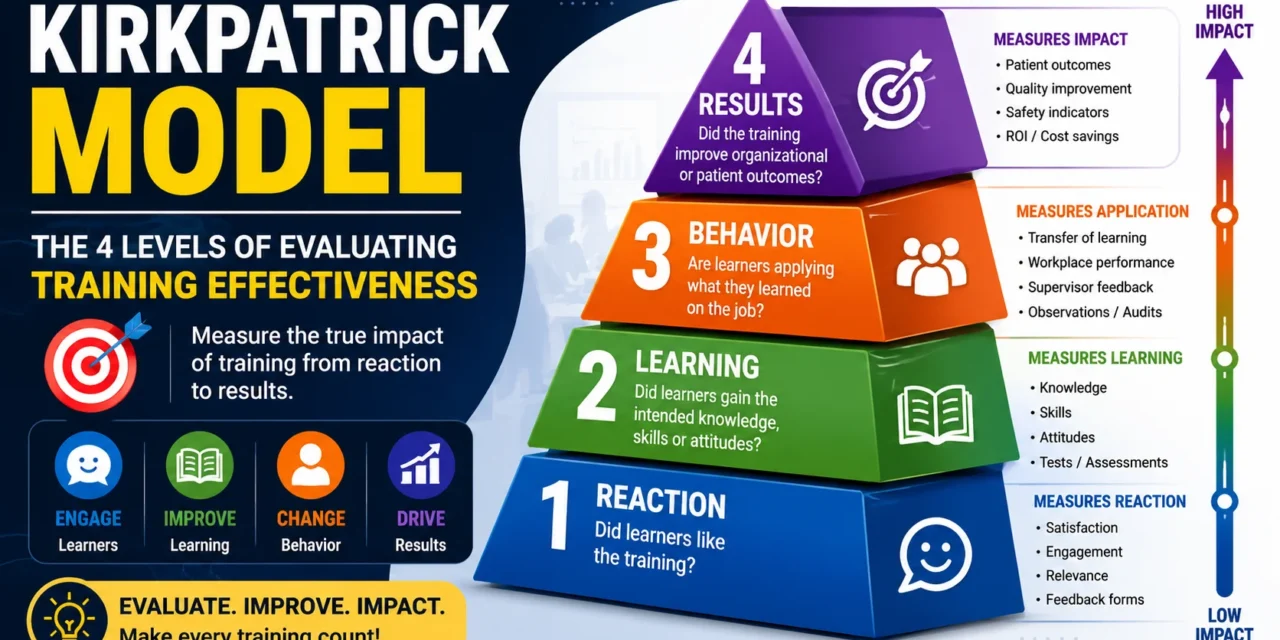
Creating a great training program is only half the job. The real question is:
Did the training actually make a difference?
Many organizations measure success by attendance or course completion. However, completing a course does not necessarily mean learners have gained knowledge, changed their behavior, or improved performance.
This is where the Kirkpatrick Model becomes invaluable.
Developed by Dr. Donald Kirkpatrick in 1959 and later refined with his son James Kirkpatrick, this model is the world’s most widely used framework for evaluating the effectiveness of training programs.
What Is the Kirkpatrick Model?
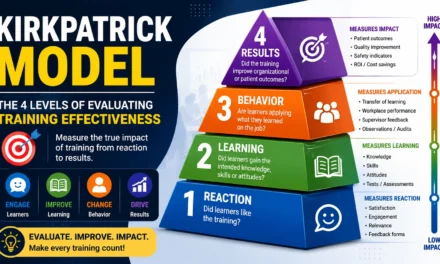
The Kirkpatrick Model is a four-level evaluation framework that helps educators and organizations determine whether a training program achieved its intended outcomes.
Instead of asking,
“Did we deliver the training?”
the model asks,
“Did the training improve learning, behavior, and results?”
It evaluates learning from the learner’s immediate reaction to the final organizational impact.
Why Is the Kirkpatrick Model Used?
Training requires time, money, and resources. Organizations need evidence that these investments produce meaningful outcomes.
The Kirkpatrick Model helps educators and trainers:
- Measure training effectiveness
- Improve course quality
- Demonstrate return on training investment
- Identify areas for improvement
- Support continuous quality improvement (CQI)
- Make evidence-based educational decisions
Rather than relying only on learner satisfaction, it measures whether learning translates into improved performance and outcomes.
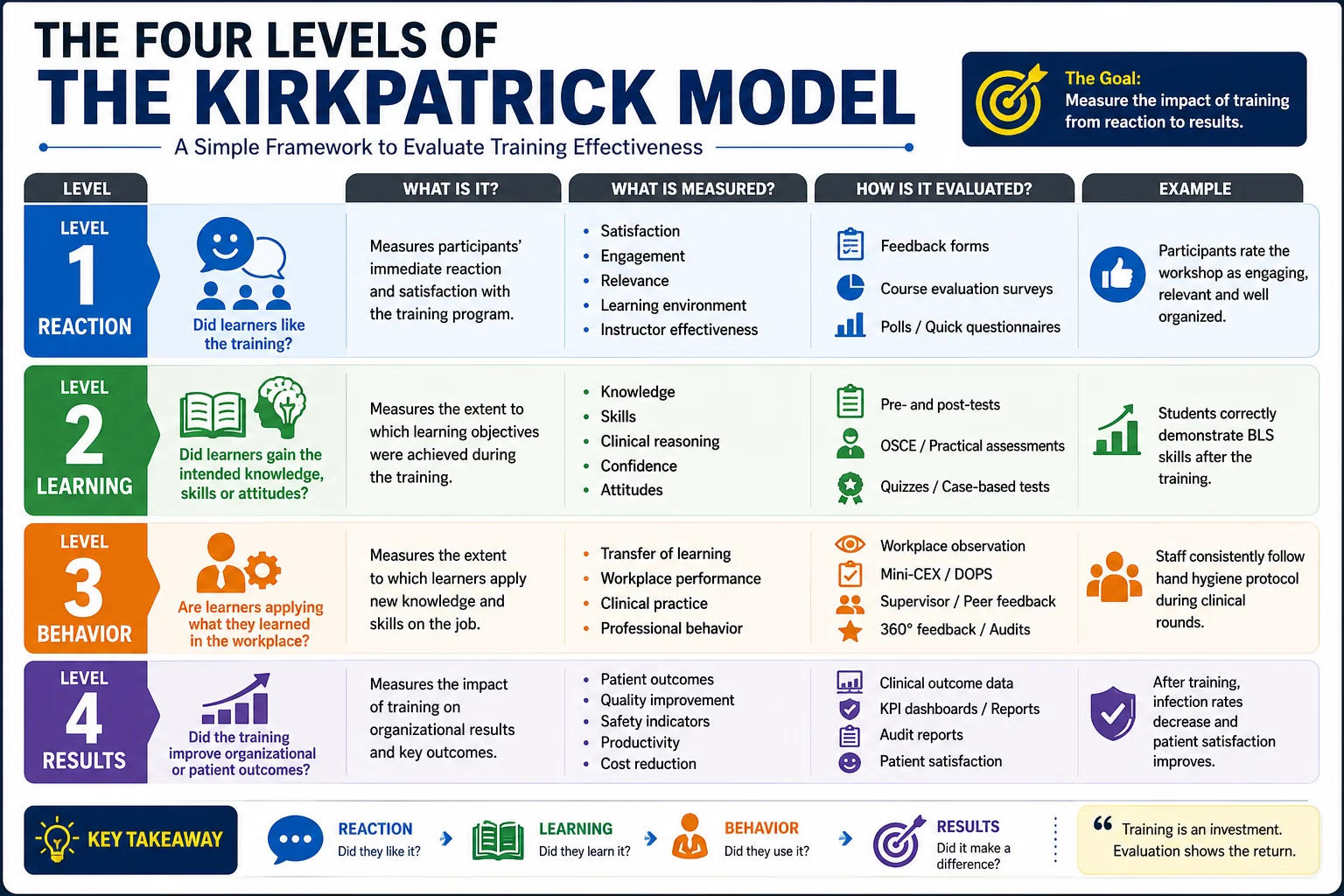
The Four Levels of the Kirkpatrick Model
Level 1 — Reaction
Question
Did learners like the training?
This level measures participants’ immediate perceptions of the learning experience.
What is evaluated?
- Satisfaction
- Engagement
- Relevance
- Learning environment
- Instructor effectiveness
Common Evaluation Methods
- Feedback forms
- Course evaluation surveys
- Polls
- Quick questionnaires
Example
Students rate a CPR workshop as highly engaging and relevant.
Key Point: Positive reactions encourage learning, but they do not prove learning has occurred.
Level 2 — Learning
Question
Did learners gain the intended knowledge, skills, or attitudes?
This level measures whether learning objectives were achieved.
What is evaluated?
- Knowledge
- Skills
- Clinical reasoning
- Confidence
- Attitudes
Common Evaluation Methods
- Pre- and post-tests
- MCQs
- OSCE
- Practical demonstrations
- Skills assessments
Example
Students correctly demonstrate Basic Life Support (BLS) after completing the course.
Key Point: Learners have acquired competence, but may not yet apply it consistently in practice.
Level 3 — Behavior
Question
Are learners applying what they learned in the workplace?
Learning only has value if it changes behavior.
What is evaluated?
- Transfer of learning
- Workplace performance
- Clinical practice
- Professional behavior
Common Evaluation Methods
- Workplace observation
- Mini-CEX
- DOPS
- Supervisor feedback
- 360-degree feedback
- Performance audits
Example
A junior doctor consistently follows the correct BLS protocol during emergency situations.
Key Point: Training has influenced real-world performance.
Level 4 — Results
Question
Did the training improve organizational or patient outcomes?
This is the highest level of evaluation.
What is evaluated?
- Patient outcomes
- Safety indicators
- Quality improvement
- Productivity
- Cost reduction
- Organizational performance
Common Evaluation Methods
- Clinical outcome data
- KPI dashboards
- Audit reports
- Patient satisfaction
- Error rates
- Quality indicators
Example
After BLS training:
- Cardiac arrest response time improves.
- Survival rates increase.
- Clinical errors decrease.
Key Point: The training delivers measurable impact beyond the individual learner.
A Practical Example
Imagine conducting a Hand Hygiene Training Program.
| Kirkpatrick Level | What to Measure | Example |
|---|---|---|
| Level 1 – Reaction | Learner satisfaction | Participants found the workshop useful and engaging. |
| Level 2 – Learning | Knowledge and skills | Learners correctly demonstrate the WHO hand hygiene steps. |
| Level 3 – Behavior | Workplace application | Staff consistently follow hand hygiene protocols during clinical rounds. |
| Level 4 – Results | Organizational outcomes | Hospital-acquired infection rates decrease. |
Notice how the evaluation progresses from “Did they like it?” to “Did it improve patient care?”
How Educators Use the Kirkpatrick Model
A simple evaluation workflow is:
Step 1: Define the learning outcomes.
Example:
“Improve safe medication administration practices.”
Step 2: Deliver the training.
Use lectures, simulations, demonstrations, and practice sessions.
Step 3: Evaluate all four levels.
- Collect learner feedback.
- Assess knowledge and skills.
- Observe workplace performance.
- Measure organizational outcomes.
Step 4: Improve the training.
Use the evaluation findings to refine the curriculum, teaching methods, and assessments.
Strengths of the Kirkpatrick Model
- Simple and easy to understand.
- Applicable across education, healthcare, and corporate training.
- Encourages outcome-focused evaluation.
- Supports competency-based education and faculty development.
- Promotes continuous quality improvement (CQI).
- Helps justify investment in training.
Limitations
- Level 4 outcomes may take months to measure.
- Organizational results are influenced by many factors beyond training.
- Behavior change requires workplace support and reinforcement.
- Measuring higher levels often requires more time and resources.
A Simple Memory Trick
Think of the Kirkpatrick Model as four sequential questions:
- Reaction – Did they like it?
- Learning – Did they learn it?
- Behavior – Did they use it?
- Results – Did it make a difference?
Key Takeaways
- Reaction measures learner satisfaction.
- Learning measures knowledge and skill acquisition.
- Behavior measures workplace application.
- Results measure organizational or patient impact.
The most effective training programs evaluate all four levels rather than relying solely on participant feedback or test scores.
How the Kirkpatrick Model Fits with Other Educational Frameworks
| Framework | Primary Purpose | Key Question |
|---|---|---|
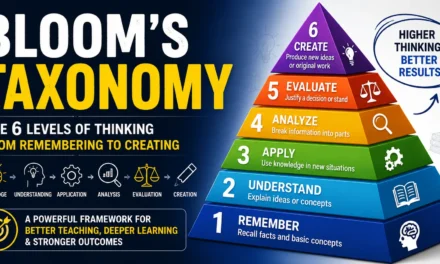
| Bloom’s Taxonomy | Design learning objectives | What should learners know and be able to think? |
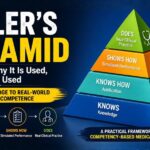
| Miller’s Pyramid | Assess clinical competence | Can learners perform in practice? |
| Kirkpatrick Model | Evaluate training effectiveness | Did the training improve learning, behavior, and outcomes? |
A Practical Integration
A complete educational program can follow this sequence:
- Bloom’s Taxonomy → Define learning objectives.
- Teaching & Learning Activities → Deliver instruction.
- Miller’s Pyramid → Assess learner competence.
- Kirkpatrick Model → Evaluate the overall effectiveness of the training program.
This creates an end-to-end framework that aligns learning design, competency assessment, and program evaluation.
Final Thought
Excellent education is not measured by the quality of the presentation alone—it is measured by the impact it creates. The Kirkpatrick Model shifts the focus from simply delivering training to demonstrating meaningful change. By evaluating Reaction, Learning, Behavior, and Results, educators can ensure that training not only informs learners but also transforms practice and improves outcomes for individuals, organizations, and ultimately the patients they serve.
This post may contain affiliate links, which means I may earn a commission for purchases made through these links. Your support will encourage us to continue adding value to you through blogs like this. Learn more on my Private Policy page.